By Jeanna Olson, RSVP Triad Volunteer
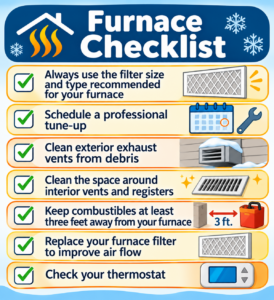
Don’t let the promise of a mild winter stop you from checking your furnace. The best way to prevent cold weather malfunctions is to schedule a professional tune-up and practice good filter maintenance.
A technician will look for cracks and leaks, wear and tear and test safety shutoffs. They also inspect sensors and switches and check for gas leaks and carbon monoxide.
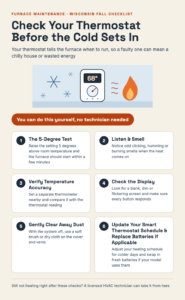
There are a few simple steps you can take that don’t require a heating and cooling specialist such as switching on the heat for 10 to 30 minutes, clearing enough space around vents and registers and checking your owner’s manual for the right filter.
The simplest test is to switch on the heat to see if warm air is coming through the vents. If you smell more than dust burning off the elements, if it stays cool or if you hear or see anything unusual, call a technician.
Take a stroll around the house to see if exterior vents are free from snow, clumps of leaves and other debris. Clearing debris from exterior furnace exhaust vents and intake pipes will prevent carbon monoxide buildup, blockages and automatic system shutdowns. It will also help to burn fuel more efficiently.
Tidy up vents and registers inside your home and make sure combustibles are kept at least 3 feet away from the furnace. Keeping flammable too close to a heating source is a leading cause of fires.
“For a furnace, this typically happens when people store holiday decorations, cardboard boxes, clothing, or cleaning supplies too close to the unit or its primary vents,” says the U.S. Fire Administration.
This holds true for all heat sources including fireplaces, wood stoves, radiators, space heaters and candles. Never use an oven to heat your home and turn off space heaters before going to bed or even when leaving the room.
Alliant Energy reminds us that it only takes a minute for something flammable to ignite and suggests a 3 foot or more clear zone around the following heat-producing equipment:
- Furnaces
- Space Heaters
- Radiators and Baseboard Heaters
- Water heaters
- Fireplaces
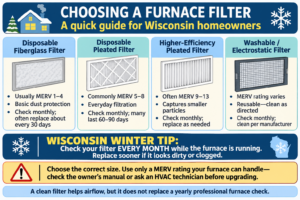
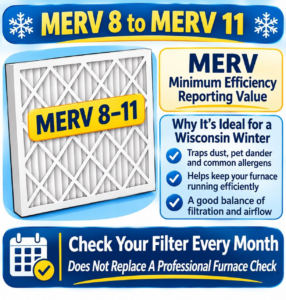
An easy and important part of furnace maintenance should include regular filter checks. This is especially important during the winter when filters fill up with debris more quickly because your furnace is working overtime. The goal is to balance air cleaning with air flow and although the most popular MERV (Minimum Efficiency Reporting Value) range is from 8 to 11, you may need to factor in irritants such as pet dander, pollen, fine dust, or smoke.
Mild winter or not, a little furnace TLC keeps your home safe and your heat running smoothly. To learn more about furnace filters, watch “Furnace Filter 101” on Alliant Energy’s PowerHouse TV YouTube Channel.